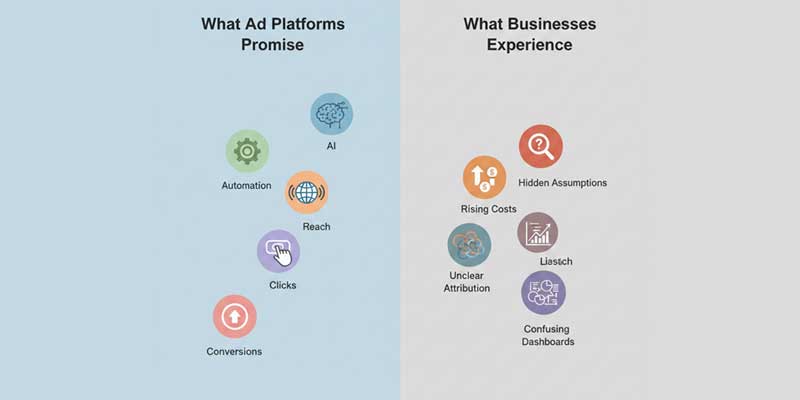
In the current digital economy, it is constantly message to brands; Run ads, that is how you grow. However, in practice, this piece of advice remains questionable and not quite straightforward for business owners not engaged in marketing terminology and dashboards. The advertising platforms are guaranteed to deliver reach, performance, and conversions. However, what they do not necessarily clarify in the beginning is how the results are created, how assumptions are built into their instruments, and what they absolutely require businesses to perform. This difference between platform text and actual business performance is not accidental; it is explained by the structure of advertising ecosystems, their optimization for their own benefit, and their tendency to favor simplicity over clarity.
This blog clarifies what advertisement platforms fail to clarify most of the time, and what a business owner needs to be informed of in order to make wiser decisions, informed investments, and solid and sustainable strategies. In between, we will discuss paid advertising insights, the strategy for creating an effective ad platform strategy, and why marketing transparency is more important than ever.
On the one hand, platforms such as Google, Meta, LinkedIn, and others are constantly discussing the issue of automation. They emphasize intelligent bidding, automated targeting, and AI-driven optimization. It sounds interesting, since no one would want to automate audience selection or bidding strategies, right?
Automation requires quality input - Data about your audience, the correct tracking of conversions, and meaningful goals. These are required to make automation a guesswork. Algorithms can absorb signals, but when they are too weak or unreliable, the results will be poor.
Robotization of platforms is a solution to platform issues, not to business issues. To take an example, the Smart Bidding at Google maximizes the perception of conversions of its algorithm, which may not necessarily be the true business value or profitability of your business. Exposure sites are maximizing clicks and conversions on the platform, not always benefiting your business's profit or lifetime value.
Black-box optimization is behavioural. With platforms that auto-adjust bids and audiences, you can no longer see what was changed or why. This creates an illusion that findings are like magic, but it is simply a lack of transparency.
This is why, in most cases, business owners will find themselves doubting whether ROI is achieved, despite the green results indicated by the dashboards. The actual maneuvering occurs behind the scenes, and the majority of platforms will not elaborate on the assumptions that have been incorporated in the automation.
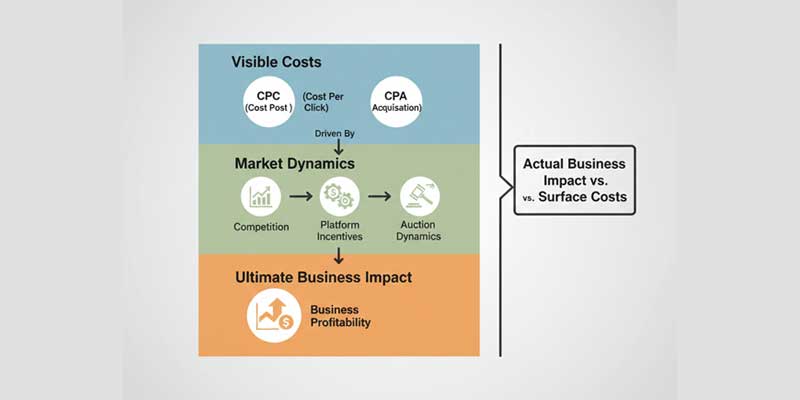
Most business owners understand terms such as CPC (Cost Per Click) and CPA (Cost Per Acquisition). What is not well spelled out in the advertising platforms is how its own incentives can influence these costs.
Increased competition = increased platform revenue. Platforms are financially advantageous as competition and bids increase. This is a conflict, but it is a fact because the higher the number of advertisers compete for a similar keyword or on the same audience, the higher you spend per click. This is not generally the foregrounding of platforms.
Ad auctions are not static. The price you pay today may be insane tomorrow due to algorithmic changes that put values to the platform first.
The term low CPA does not imply a profitable campaign. A low-cost lead is only valuable when it translates into business at good rates. Platforms are very efficient at optimizing for what they can measure, not for your bottom-line measures.
It is essential to know the secrets of cost metrics. Business owners must not pursue low CPC or CPA goals blindly, as these should reflect the true value of the business, which is not necessarily reflected in ad dashboards.
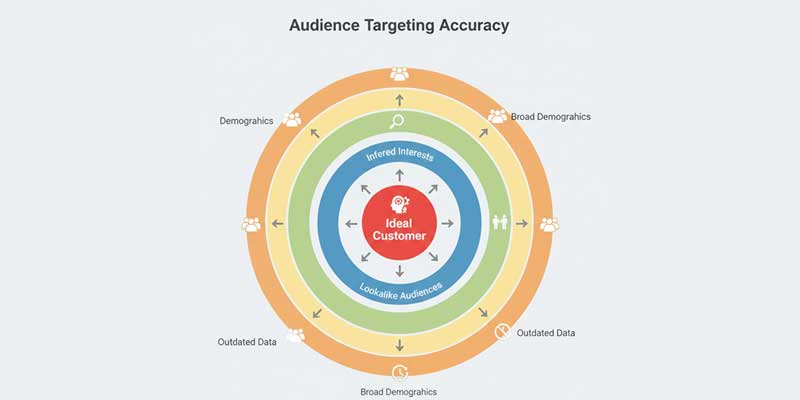
Precise targeting is among the largest marketing transparency assets of the ad platforms strategy. They usually leave out here, however:
Precise audience targeting does not ensure relevance. Social networks such as Meta allow you to target individuals who are similar to your clients - but different platforms define similarity by the platform algorithm, rather than your business performance.
Targeting (Interest and demographics) is approximate. Online behavior is used to infer audience interest, but it is sometimes outdated, misclassified, or too broad. This will mostly result in the wastage of impressions.
The issue of data governance influences accuracy. As privacy laws and data limits continue to tighten, there is less real-time information available on platforms than there was in the past. Consequently, targeting becomes less accurate over time unless companies invest in first-party data (such as email lists or on-site engagement metrics).
This implies that, while platforms sell the concept of perfect audience targeting, business owners are obliged to use platform tools alongside actual audience research, customer interviews, and data sources that platforms lack.
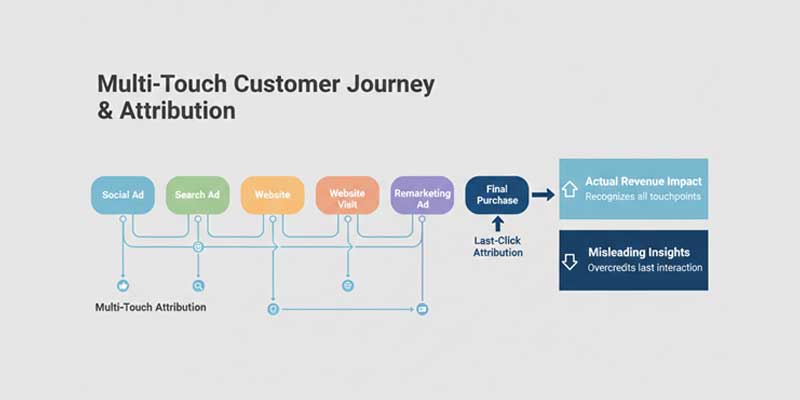
Your ad platform strategy uses an attribution model when you get information about the origins of conversions. However, the assumptions of these models are discussed by platforms in very simple terms.
The effect of last-click attribution is biased. When a platform uses last-click attribution (the default in many cases), the last touchpoint before a purchase is credited, even if the customer used other platforms along the way.
Multi-touch attribution is complex. Models of multi-touch platforms are not always publicly visible, nor is how they prioritize each interaction. Is the initial click more significant than the intermediate one? Who knows?
The tracking across devices is not complete. Without the right setups, such as user login tracking or analytics integrations, platforms may not connect the customer journey when an operator places an ad on mobile and establishes a purchase on desktop.
This has become a common situation in which dashboards show a high conversion credit to a particular platform, even though the actual journey spans numerous touchpoints. Without knowing these attribution assumptions, business owners will be able to misestimate where the value was actually derived.
The ad platforms strategy will be happy to report to you how many impressions, clicks, or views your advertisements received, but they may not be willing to discuss creative fatigue or insights into the creative strategy.
Performance declines are usually creative and not algorithmic. Repeated use of the same advertisement causes boredom among viewers and decreases interest. Platforms can indicate more budget, and the actual solution is a creative refresh.
Weak creativity cannot be cured by algorithms. Optimization is not effective if an ad is not resonant. Platforms do not necessarily offer insight into creative performance beyond surface measures in a diagnostic manner.
Dissimilar formats reach various benchmarks. For example, video may require shorter hooks, responsive ads should be varied, and carousel ads should have story arcs. Raw measures will not explain why some formats perform better.
Effective campaigns require a creative approach and a combination of creative and algorithmic implementation, rather than automation.
Dashboard is easy to believe, but it does not give the complete picture.
Conversion tracking gaps. If tracking is disordered, conversions will be underreported or misattributed. Platforms do not often indicate the absence of full tracking.
The timeliness of data may be misleading. Most of these platforms present initial outcomes that are later modified, and yet business owners tend to make decisions prematurely.
Information that has been sampled or simplified. In order to maintain dashboards accessible, platforms sample data, which may conceal subtleties. This may cause making decisions that are not based on a real distribution but on averages.
That is the reason why platforms promote users to overlay outside analytic instruments, tailor-made tracking applications, and business performance indicators to platform dashboards.
Advertising platforms are oriented towards media spending; however, the business owners should consider more general expenses:
Knowing these actual advertising expenses will help business owners anticipate budget shocks and budget accordingly.
The vast majority of ad platforms' strategy is very effective at describing technical aspects (how to implement campaigns, which goals to use, and which audiences to target). What they fail to make clear is:
This breach of communication is partly intentional: platforms are designed to serve audiences at all levels of experience, and simplifying messages often requires excluding complex realities.
It is there that the business owners should intervene in a curious, educated, and strategic manner.
With any campaign that is to be launched, it is important to discuss the objective of the campaign in terms of brand awareness, lead generation, revenue growth, or customer retention. Various objectives need various measures - and various optimization programs.
It is all about good data to support any paid advertising insights endeavor:
This will ensure that platforms have the right signals to capitalize on.
Supervision of automation should be carried out. Nevertheless, human experience is necessary to:
Switch ad formats, update messaging, and experiment with creative thoughts. Platforms are not capable of doing all of that. Innovation leads to involvement.
Do not use platform dashboards only. Instead, monitor KPIs such as the business's revenue per campaign.
This creates transparency regarding the way advertising is involved in actual business.
A mature marketing agency will be essential to bridge the gap between the platform's complexity and the business's clarity. Bud is a Bangalore-based creative ad agency which is of the belief that fresh, result-oriented communication should be made to suit the objectives of the brand. The team of Bud goes beyond placing advertisements but dissects the strategic planning and data analytics, as well as the clever storytelling, to give the campaigns meaningful results that are in line with the business goals of a client.
Being a thoroughly creative agency with strong strategic considerations, Bud helps businesses understand not only how to run ads, but also why some are effective and why some fail. This humanistic philosophy will make sure that a campaign is constructed in a simple, purposeful, and quantifiable manner and transform the complexity of the platform into actionable insights.
The advertising platforms are effective instruments with enormous reach and strength. However, out of context, strategy, and lack of understanding, business owners may find themselves running after metrics that do not translate to actual growth. The fact is that platforms give the machinery of advertising, but a blueprint of success must be created by businesses.
In good advertising, there must be:
By identifying the areas that platforms fail to clarify and going out of their way to address them, business owners can make ad spend not a cost center but a driver of growth.
WE ARE AN OFFICIAL GOOGLE PREMIER PARTNER