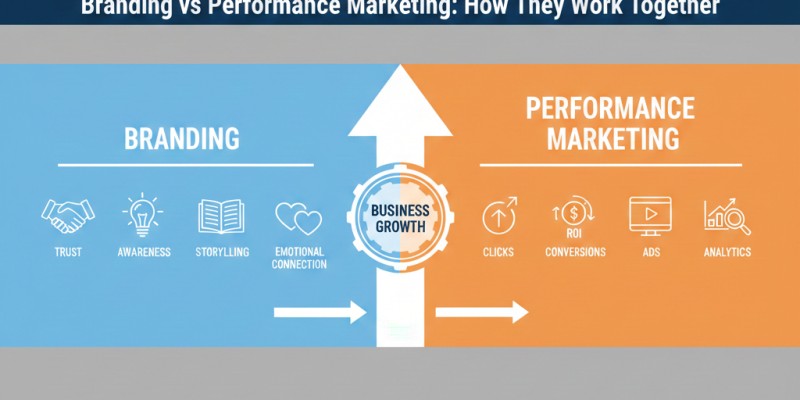
If branding vs performance marketing is confusing for your business, think of it this way:
branding builds the world your business lives in, and performance marketing is the engine that
motivates results. Both are essential for a strong brand growth strategy.
When businesses treat their competitors as their business partners, their growth rate decreases. Many brands today focus only on short-term results, such as ads and quick conversions. The performance campaigns stop delivering consistent results because they lack effective branding methods that build customer trust and drive product demand.
This is a common challenge in today’s market. Customer acquisition costs are rising, and gaining attention is becoming more difficult. That’s why a balanced approach to branding vs performance marketing is key. When both work together as part of a clear brand growth strategy, businesses can build long-term visibility while also driving steady leads and sales.
Brand marketing is about everything that has to do with people's feelings towards your business. It is aimed at creating awareness, trust, and a deep emotional bond with your audience in the long run. Rather than seeking quick sales, it upholds a long-term brand growth strategy that makes your brand memorable to your customers so that when they are willing to purchase, they choose yours.
When it comes to branding vs performance marketing, brand marketing is an important element in ensuring your business is an exception in the sea of competitors. It enhances trust and credibility and develops customer loyalty, which is hard for competitors to match. Having a strong brand makes performance marketing campaigns more efficient and economical.
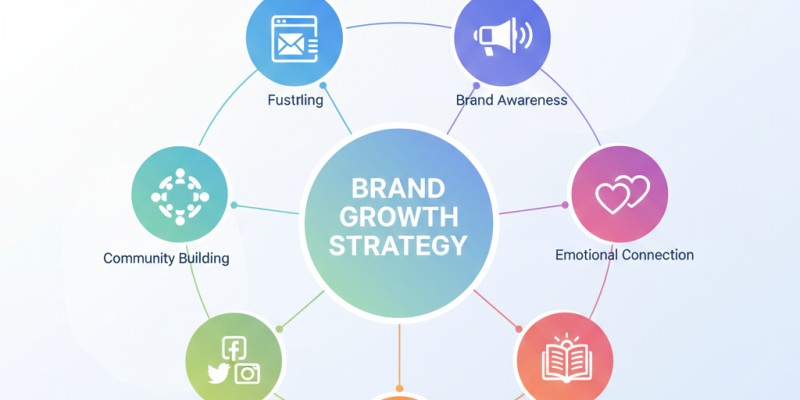
An effective brand growth strategy includes activities such as raising brand awareness and recall, telling significant brand stories and values, and creating an emotional bond with customers. It is also concerned with trust, reputation, and cohesive communication through a channel.
The typical marketing channels of the brand consist of social media content, partnerships with influencers, PR and thought leadership, video-based storytelling, and community-building programs. All these contribute towards establishing a high level of success in the long run.
Although brand marketing is time-consuming, it underpins the broader branding framework rather than performance marketing, as each campaign becomes more effective and helps your business grow continuously.
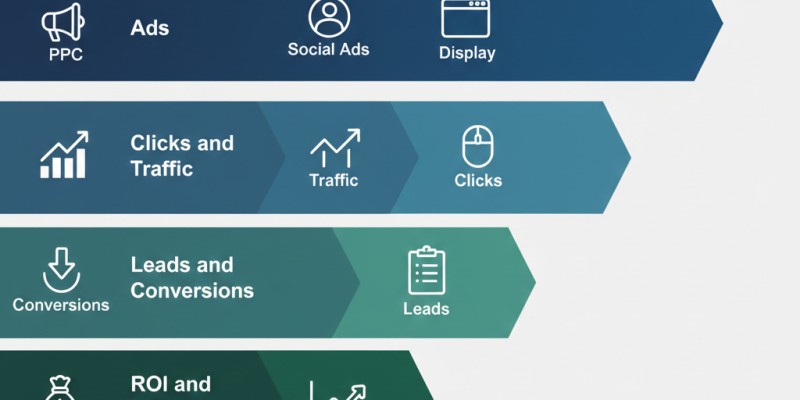
All that is involved with performance marketing is to achieve quick, measurable outcomes for your business. Each campaign would produce a specific action, such as clicks, leads, app installs, or sales, and the achievement would be tracked with clear metrics. This is a good method for balancing branding and performance marketing, where a company can easily identify what is working and scale it.
Performance marketing is an important part of the brand growth strategy of many startups and D2C brands, as it provides predictable income and immediate turnover. It emphasizes the direct response campaigns, high conversions, return on investment (ROI), return on ad spend (ROAS), and cost efficiency. By constantly testing and optimising, businesses are able to make superior decisions using actual data and optimise the performance of the campaigns over time.
Typical performance marketing vehicles include search advertisements (PPC), social media ads with a distinct call-to-action button, affiliate marketing, retargeting, and display ads. These avenues enable companies to be fast and accurate when targeting potential clients.
Nevertheless, when comparing the two branding and performance marketing, one should keep in mind that a well-established brand accompanies performance marketing. A lack of brand trust and brand awareness is costly, harder to change, and makes long-term growth challenging to sustain.
Research clearly shows that branding vs performance marketing is not a choice of one over the other—it’s about balance. Studies by the analyst reveal that long-term brand investment delivers the highest profit growth. A strong brand growth strategy builds awareness, trust, and demand, while short-term performance campaigns support this demand by converting it into leads and sales.
Recent research also highlights a common issue: many marketers focus too heavily on performance marketing alone. In fact, over half of UK marketers believe their campaigns rely too much on short-term tactics, even though brand advertising is proven to be one of the most effective ways to achieve long-term business goals.
The takeaway is simple—businesses that align branding vs performance marketing with a clear brand growth strategy are more likely to achieve sustainable growth, stronger customer loyalty, and better overall ROI.
You can optimise all advertisements and monitor all clicks, but it will not yield actual results until people recognise your brand and are assured of what you are offering. This is where branding vs performance marketing comes in. A good brand generates familiarity, trust, and recall, which are three elements that influence customer decisions and help any organization succeed in the long term.
Branding is an important element of any brand growth strategy, as it builds memory, meaning, and mindshare. This is what makes customers remember you, like you, and select you when they are willing to purchase. Without such a foundation, even high-performing ads cannot convert.
A poor brand increases the efforts and expenses of your performance campaigns. The good brand, however, increases click rates, lowers acquisition costs, and boosts conversions. This is where true development occurs - when branding and performance marketing become one integrated entity.
Our team can help you with developing a better brand growth strategy or enhancing your paid campaign outcomes. Discover our branding and digital marketing solutions to learn how we can merge brand building and performance marketing to get enhanced performance in your business.
Performance marketing techniques do deliver results, particularly in the short run. They are quick and measurable, and can be used to track leads and sales. However, in the debate between branding and performance marketing, it should be noted that performance does not have all the answers.
In the modern world, increased competition, changes in privacy, and the decline of third-party cookies are raising the cost of paid advertising. The more businesses rely on ads alone, the more their expenses continue to rise, and outcomes become difficult to sustain. It is here that a good brand growth strategy is necessary.
Performance marketing must be able to capture but not generate demand. Unless people are aware of your brand or believe it, you find yourself paying more simply in order to persuade them. This forms an expensive process that slows down growth.
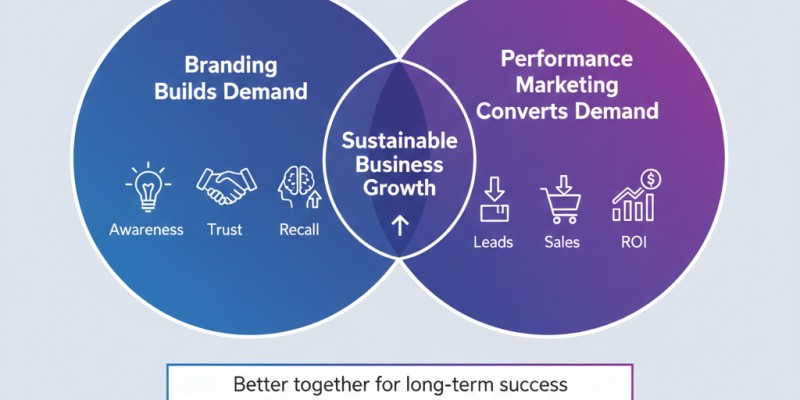
The smarter approach is to balance branding and performance marketing. Establish a strong brand that builds awareness and trust, and then use performance marketing to convert that demand into leads and sales. Such a mix goes hand in hand with a sustainable brand development approach and yields improved results in the long term.
At Bud, we help businesses grow with the right mix of branding services and performance marketing services. Our team combines creative brand strategy with data-driven marketing to build a strong presence that not only looks professional but also delivers real business results.
Our marketing agency in Bangalore designs unique branding solutions, marketing strategies, and business development programs that match your company's objectives. We develop new companies from the ground up and enhance existing marketing efforts through integrated strategies that drive sustained business growth.
Want to strengthen your brand and improve your results? Explore our marketing solutions or get in touch with our team for a detailed discussion on how our branding and performance marketing can help your business grow.
WE ARE AN OFFICIAL GOOGLE PREMIER PARTNER