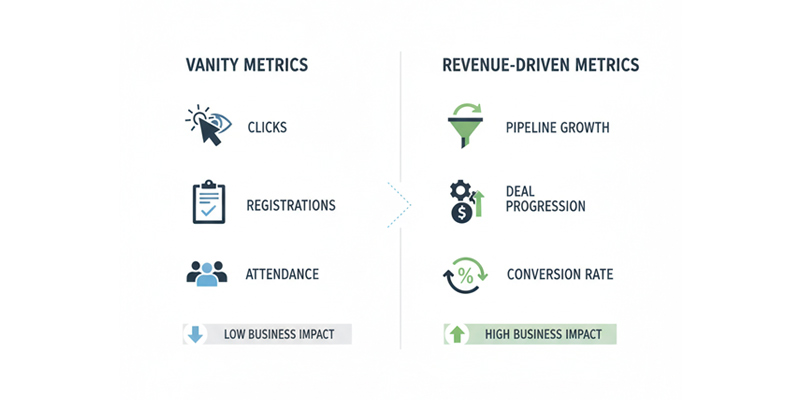
For many years, B2B event success was measured by simple marketing metrics such as clicks, views, registrations, and attendance. These numbers are easy to track—but they are often given more importance than they deserve.
The reality is different. Only a small percentage of event leads turn into real sales opportunities, and even fewer result in closed deals. High engagement looks good on reports, but it doesn’t always mean real business impact. This is where better conversion tracking becomes essential.
Because of this gap, the definition of success has changed.
In complex B2B buying journeys—especially in India, where enterprise decisions involve multiple stakeholders and long decision cycles—events are no longer judged by attendance. They are judged by influence. Did the event help move accounts forward? Did it speed up evaluations or improve conversion rates?
As CRM systems and data maturity improve, leadership teams now expect deeper digital performance analysis. They want insights, not activity summaries. Business leaders want to know how events support pipeline growth, improve deal speed, and contribute to revenue—not just how many people registered or showed up.
This shift reflects a larger change in marketing accountability. The future of B2B events belongs to teams that focus on conversion impact and revenue contribution, not just attendance numbers.
From clicks to meaningful conversations, our marketing agency at Bud turns data into real success stories that fuel brand growth.
At B2B events, every engagement signal does not mean the same thing. Some marketing metrics look impressive but do not show real buying interest.
For example, a registration only shows intent to attend. A click shows curiosity. Neither confirms that a prospect is ready to buy. What truly separates high-performing events from noise is the ability to measure engagement depth—how much attention, intent, and effort an attendee is actually putting in.
Engagement depth helps answer three important questions:
Session retention time is one of the strongest indicators of relevance. Attendees who stay for the full session, ask questions, or interact with live features are clearly interested in the topic. On the other hand, early exits and minimal interaction often signal low perceived value or a mismatch in expectations.
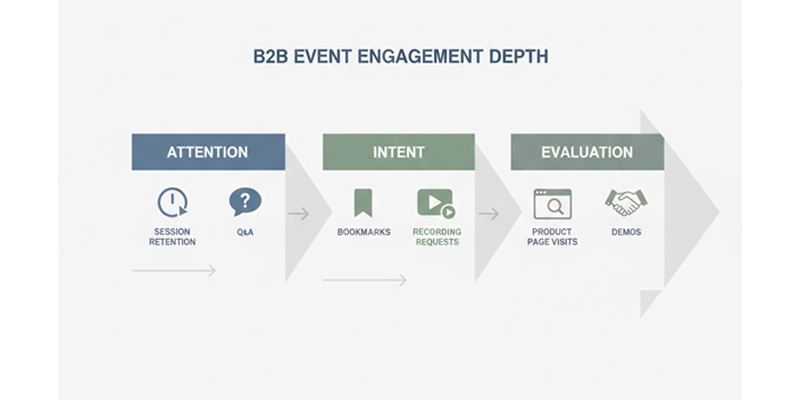
Conversion tracking becomes even more effective when intent signals are added. Actions such as bookmarking sessions, requesting recordings, or visiting product and solution pages after the event show movement from awareness to evaluation. These behaviours matter more than surface-level engagement.
This is especially important in the Indian B2B market. Buyers here rarely contact sales teams immediately. Most evaluation happens quietly through research, internal discussions, and comparison. Strong digital performance analysis captures these small actions and reveals early account-level interest long before a sales conversation begins.
Content preferences also provide valuable insight. Repeated engagement with formats like technical deep dives, case studies, compliance sessions, or implementation discussions often indicates growing buying intent, while lighter content usually reflects early-stage exploration.
Together, engagement depth changes how success is defined. It is no longer about how many people attended, but who paid attention, what interested them, and what they did next. This approach helps marketing teams improve follow-ups, refine their content strategy, and connect events more closely to revenue outcomes rather than just awareness.
The mid-funnel is where B2B events create real business value, but it is also where traditional marketing metrics often fall short. Basic reports usually focus on leads and registrations, missing what happens between early interest and sales conversations.
This gap exists in the evaluation stage. At this point, buyers compare solutions, involve more stakeholders, and decide whether a product fits their needs. Most of this activity does not generate instant leads or form fills, which is why it is often ignored in standard reporting.
This is where smarter digital performance analysis makes a difference.
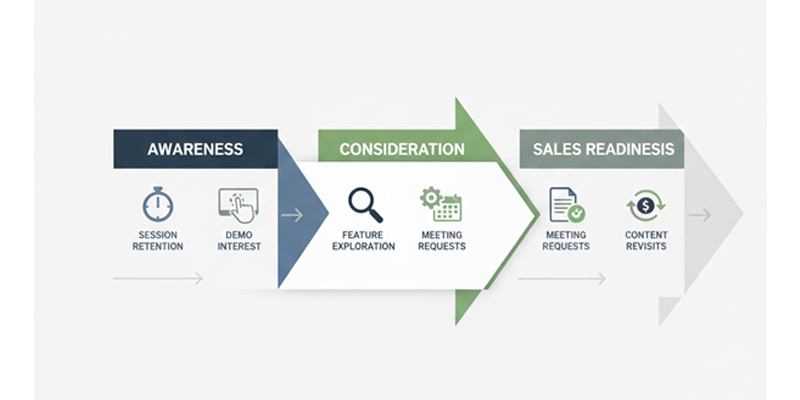
Mid-funnel influence shows up through specific behaviours, such as interest in product demos, deeper exploration of features, requests for meetings or expert follow-ups, and repeated engagement with technical or case-study content. These actions show that buyers are moving beyond awareness and into serious evaluation.
Interest in demos is a strong signal of progress. When attendees explore solution walkthroughs or feature-level content, they are no longer browsing—they are assessing fit. Meeting requests are an even stronger indicator. When multiple people from the same company ask for discussions, it suggests shared evaluation rather than individual curiosity. This is especially important in India, where buying decisions usually involve teams across IT, finance, operations, and leadership.
Revisiting content also provides clear insight. When attendees return to recorded sessions, technical documents, or case studies, it often means internal sharing and deeper review. This behaviour is commonly seen just before vendor shortlisting.
With proper conversion tracking, these actions can be linked to CRM stages. This helps teams understand which event touchpoints moved buyers from awareness to consideration, which accounts are progressing quietly without filling forms, and where events are supporting sales momentum behind the scenes.
This level of visibility turns events from one-time activities into measurable drivers of pipeline growth—without relying only on last-click attribution or surface-level metrics.
In B2B marketing, event success is defined by what happens after the event, not just what happens during it. Strong marketing metrics focus on outcomes, not just attendance or engagement.
Leadership teams want clear answers. Did the event help move deals forward? Did it shorten the buying cycle? Did it increase the conversion rate? Answering these questions requires outcome-based measurement supported by accurate conversion tracking.
Conversion impact can be seen through practical signals such as opportunities moving to new CRM stages after the event, shorter sales cycles for accounts that engaged with the event, and higher deal values or improved win probability for influenced opportunities. These signals show whether the event contributed to real business progress.
By comparing accounts that showed high-intent event engagement with those that did not attend or interact deeply, teams can determine whether events helped accelerate evaluation or revive stalled deals. This kind of comparison is a key part of effective digital performance analysis.
Attribution also plays a major role. Instead of treating events as a last-click touchpoint, smart attribution models connect specific event interactions—such as sessions attended, demos explored, or meetings scheduled—to revenue outcomes. This reveals whether the event supported, accelerated, or directly influenced conversions.
When events are measured this way, they are no longer seen as optional marketing activities. They become proven conversion drivers that revenue leaders can confidently include in budget planning and long-term growth strategies.
Event data loses its value when it stays separate from revenue systems. Without the right marketing metrics, it becomes difficult to understand how events actually impact business growth.
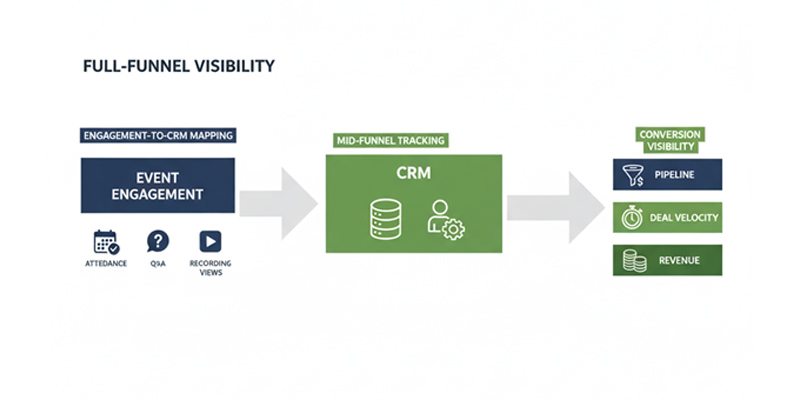
Bud is designed to solve this by connecting engagement signals across the entire B2B funnel. It links what happened during the event with what changed later in the sales pipeline, using clear conversion tracking and structured data.
Instead of treating events as one-time activities, Bud integrates them into a continuous, measurable revenue journey. This approach supports deeper digital performance analysis and better decision-making.
Key interactions, such as session dwell time, demo interest, meetings, and content engagement, are directly mapped to accounts, contacts, and possibilities in the CRM. This ensures no important signal is lost.
Bud identifies which event touchpoints helped move prospects from awareness to consideration, without depending only on form submissions or last-touch attribution.
Teams can track stage movement, deal speed, and influenced revenue for accounts that engaged with events, making conversion impact clear.
Event performance is presented in terms of pipeline impact, conversion movement, and future revenue potential—without manual data matching across teams.
By connecting marketing engagement with revenue outcomes, Bud helps teams treat events as a shared growth engine rather than an isolated marketing channel.
Modern B2B events are no longer measured solely by attendance numbers or activity volume. Today, success is judged by influence and business impact, supported by meaningful marketing metrics.
When engagement is tracked for depth, intent, and real outcomes through accurate conversion tracking, events stop being one-time activities. Instead, they become repeatable growth systems that support the entire funnel.
With strong digital performance analysis, leadership teams gain clear visibility into which interactions drive progress, which audiences are moving closer to conversion, and where future investment will deliver the highest returns.
This smart use of data shifts events from simple awareness tools to reliable revenue contributors. Measured the right way, events are no longer costs to explain—they become scalable growth engines that leadership can trust and expand with confidence.
As a digital marketing agency, Bud helps brands move beyond clicks to meaningful conversations by tracking the metrics that truly reflect real marketing success.
WE ARE AN OFFICIAL GOOGLE PREMIER PARTNER