In today’s digital-first world, running ads is easy—but turning strangers into loyal customers is not. Many businesses invest heavily in ads yet struggle to see consistent returns because their campaigns focus only on clicks, not the whole journey. This is where smart advertising funnels make all the difference.
A strong advertising funnel strategy gives your business a clear structure to attract the right audience, build trust, and convert leads with confidence.
When you understand how each stage of the advertising funnel works, you remove guesswork and follow a clear system that guides people from their first interaction to the final purchase. A well-planned funnel helps you improve targeting, manage growth, and achieve consistent results across all marketing channels.
Many businesses struggle because they treat marketing as a one-time activity instead of a step-by-step journey. Real results come from using the advertising funnel stages with purpose and planning.
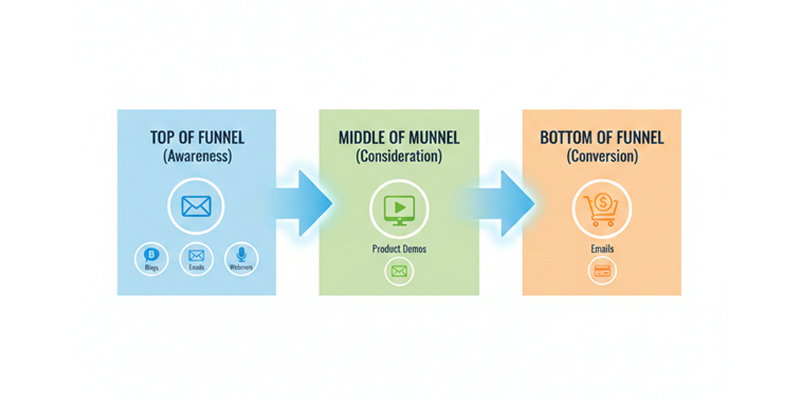
By understanding how customers move through awareness, consideration, and conversion, you can generate better-quality leads and turn them into loyal customers more efficiently.
This guide explains the complete advertising funnel, shows how each stage works, and helps you connect them into one smooth, high-performing pipeline. You’ll learn proven strategies to attract leads, nurture them with value, and guide them toward action with ease.
An advertising funnel is a step-by-step journey that guides people from discovering your brand to making a purchase and eventually becoming loyal customers.
A common way to understand the marketing funnel is through five stages: awareness, consideration, conversion, retention, and advocacy. Each stage focuses on a different customer mindset. This guide explains the funnel structure in detail.
Another widely used approach—and the one covered in this article—simplifies the process into three main stages: top of funnel, middle of funnel, and bottom of funnel.
While advertising funnels can exist both online and offline, this article focuses only on online advertising funnels, especially those used in ecommerce marketing.
Ecommerce marketing funnels differ from offline funnels because every online interaction generates trackable data. This data helps brands understand customer behaviour and improve targeting across digital channels.
For example, businesses can personalise content for different audiences, run A/B tests on landing pages, and use real-time optimisation to improve performance at every funnel stage.
Each funnel stage may include multiple touchpoints, and shoppers often move back and forth between stages before completing a purchase.
The ultimate goal of an advertising funnel is to build long-term relationships by guiding customers through each stage—turning first-time visitors into repeat buyers and brand advocates.
To improve your sales funnel performance, your strategy must focus on customer needs—not just business goals. Even the best funnel will fail if your offer doesn’t solve a real problem.
iStart by defining your ideal customer profile (ICP) using real data, not assumptions. Understand their pain points, challenges, past solutions, and the results they care about most.
Use customer reviews, interviews, and market research to gather insights directly from your audience. Once you understand what they truly need, align your goals with their demands.
When your product is positioned as the right solution—not a pushy sale—your funnel becomes stronger, conversions improve, and leaks are reduced.
Many B2B businesses lose leads because sales and marketing teams work in silos. When teams don’t communicate, leads drop off and conversions suffer.
Marketing’s role is to attract and nurture leads, while sales focuses on closing deals. If lead quality is poor or feedback is missing, the funnel breaks.
To fix this, ensure both teams agree on the sales funnel stages and lead qualification criteria, and that the handoff process is smooth. Regular discussions help improve lead quality and conversion rates.
When sales and marketing work together, leads move smoothly through the B2B sales funnel, turning cold prospects into customers.
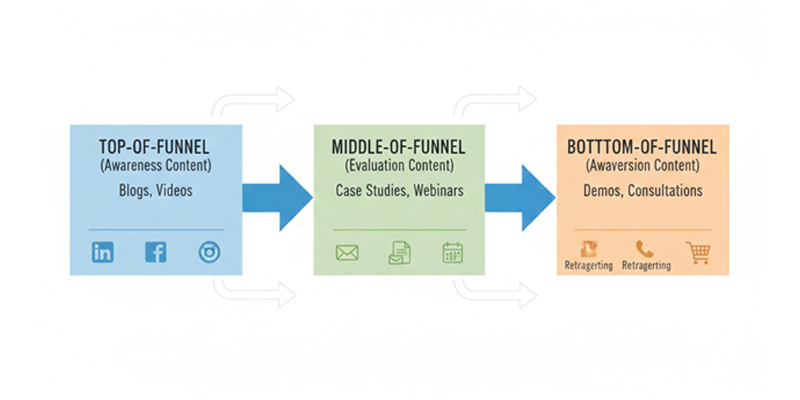
Content moves prospects through your B2B sales funnel, but each stage requires a different approach. The key is to share the right content at the right time.
Top of Funnel (Awareness)
At this stage, prospects are learning about a problem. Focus on education, not selling.
Middle of Funnel (Interest & Evaluation)
Prospects are comparing solutions. Position your brand as the best option.
Bottom of Funnel (Decision & Engagement)
Leads are ready to convert. Remove doubts and build trust.
When content aligns with each funnel stage, prospects move forward easily, friction reduces, and conversions increase.
Your customers are active across multiple platforms, so your sales funnel strategy should meet them where they are—online and offline.
At the top of the funnel, use channels like LinkedIn, Facebook, and Twitter to build awareness.
In the middle of the funnel, employ prospects through webinars, personalised email campaigns, and retargeted ads.
At the bottom of the funnel, drive conversions with personalised sales pitches, direct emails, and one-on-one calls.
Offline touchpoints such as events, workshops, and product launches also help build trust and move leads through the funnel. When each channel supports the right stage, your funnel stays efficient and conversion-focused.
Clear and consistent communication is critical to a high-performing sales funnel. One poor interaction can cause potential customers to drop off.
Use live chat and intelligent chatbots to respond quickly, set clear response guidelines for your team, and maintain consistent messaging across all platforms.
When communication is smooth and timely, trust increases, customer experience improves, and your funnel converts better.
A sales funnel needs ongoing optimisation to perform well. It’s not a one-time setup—it requires regular tracking and improvements.
Monitor key metrics like lead conversion rate, cost per acquisition (CPA), customer lifetime value (CLV), and drop-off points. These insights show where your funnel is working and where it needs fixing.
If leads drop off during evaluation, the issue could be unclear pricing, weak value messaging, or stronger competitor offers. Review these exit points regularly and optimise them to improve conversions and overall funnel performance.
At the heart of every successful funnel is customer journey mapping.
Customer journey mapping helps businesses understand:
By mapping the journey, businesses can align ads, content, and landing pages with real customer behaviour instead of assumptions.
This clarity allows you to create a funnel that feels natural and helpful—rather than pushy.
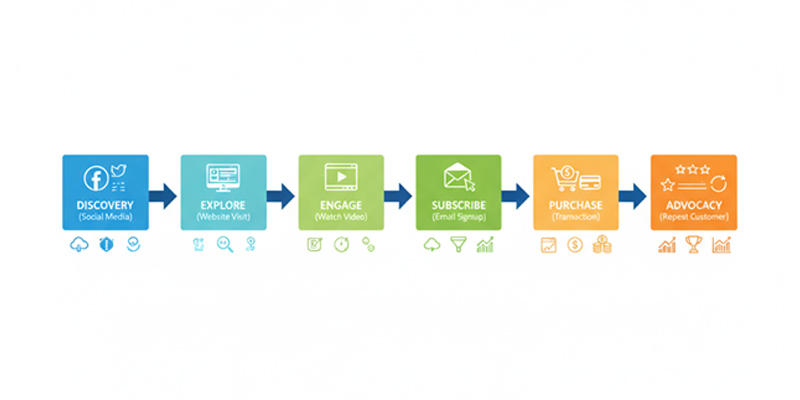
A successful conversion funnel strategy connects all stages into one seamless experience.
Key elements include:
Instead of pushing the same message to everyone, a conversion-focused funnel adapts communication based on where users are in their journey.
This not only improves conversions but also reduces wasted ad spend.
Paid advertising plays a critical role at every funnel stage—but only when used strategically.
Paid ads optimization ensures that:
Each stage requires different creatives, formats, and objectives. Treating all paid ads the same often leads to poor performance.
When optimised correctly, paid ads act as the engine that moves users smoothly through the funnel.
One of the most potent aspects of advertising funnels is retargeting.
Not every user converts on the first visit. Funnels allow businesses to re-engage users who:
By showing tailored messages based on past behaviour, businesses can significantly increase conversion rates while keeping costs under control.
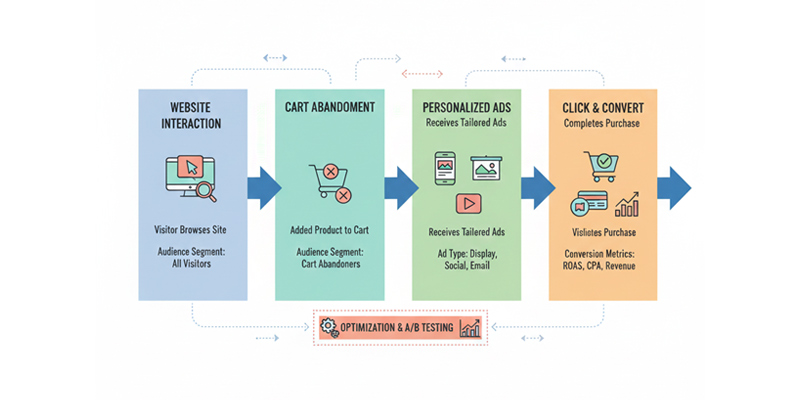
Smart funnels are built on data.
Key metrics to track include:
Continuous testing and optimisation help identify weak spots and improve performance over time.
This data-first approach is what separates random advertising from scalable growth.
Smart advertising funnels help businesses turn cold audiences into loyal, high-value customers by guiding them through every stage of the customer journey with targeted messaging and personalised touchpoints. Instead of treating all visitors the same, a well-structured funnel aligns audience intent—from awareness to conversion—so paid ads optimization delivers measurable results. When content, ads, and channels work together, brands reduce drop-offs, improve engagement, and increase conversions. However, while funnel concepts are simple, execution requires experience and precision.
A trusted Advertising agency in Bangalore or a Performance marketing agency in Bangalore helps align funnel strategy with business goals, integrate ads with landing pages and content, and optimise performance at every stage. For businesses running paid campaigns, working with a skilled PPC Agency in Bangalore ensures ads are not just visible but profitable—turning marketing spend into long-term customer value.
Smart advertising funnels are no longer optional—they are essential for businesses that want consistent, high-quality growth.
By combining advertising funnels, thoughtful customer journey mapping, a strong conversion funnel strategy, and continuous paid ads optimization, businesses can turn cold audiences into loyal, high-value customers.
At Bud, we believe great advertising is not about pushing messages—it’s about guiding people. With the right funnel strategy, every interaction becomes a step toward trust, conversion, and long-term success.
WE ARE AN OFFICIAL GOOGLE PREMIER PARTNER