AI influenced everything everywhere in 2025, and digital marketing was no exception. From content creation and ad optimisation to customer support and data analysis, AI is changing how marketers plan, work, and achieve results.
But the real shift isn’t about whether marketers should use AI anymore. One of the biggest AI trends in digital marketing in 2025 was that brands were effectively using it.
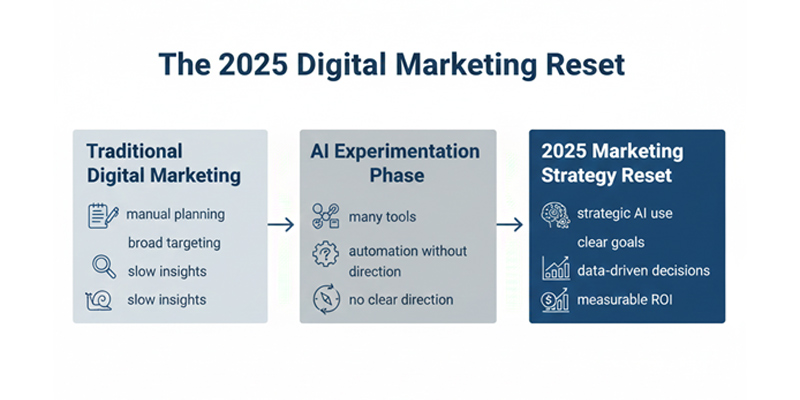
As AI tools evolve rapidly, new questions are emerging. Are marketers ready to adapt? Do businesses have a clear AI strategy, or are they just experimenting without direction? In 2025, a marketing strategy reset means moving beyond AI experimentation and aligning technology with clear business goals, customer insights, and measurable ROI.
In this blog, we’ll break down the key AI trends shaping digital marketing in 2025 and explain what they mean for your business. AI is driving smarter campaigns and better targeting in digital marketing 2025.
AI adoption in digital marketing is growing fast. According to Marketing Week, 54% of marketers now use AI in their daily work, up from just 37% last year. This sharp increase shows that AI is no longer an optional tool—it has become a core part of modern marketing.
Today, AI tools like ChatGPT, Jasper, and Midjourney are fully integrated into everyday workflows. Marketers use them to write ad copy and social media content, create product visuals, analyse audience behaviour, and even predict campaign performance. By combining speed with data-driven accuracy, AI is helping marketers work smarter and deliver better results. Data-driven decision-making is at the core of recent business marketing changes.
Creativity isn’t disappearing—it’s evolving. Generative AI trends in 2025 show that marketers are using AI not just to save time, but to unlock new creative ideas and scale content faster than ever before.
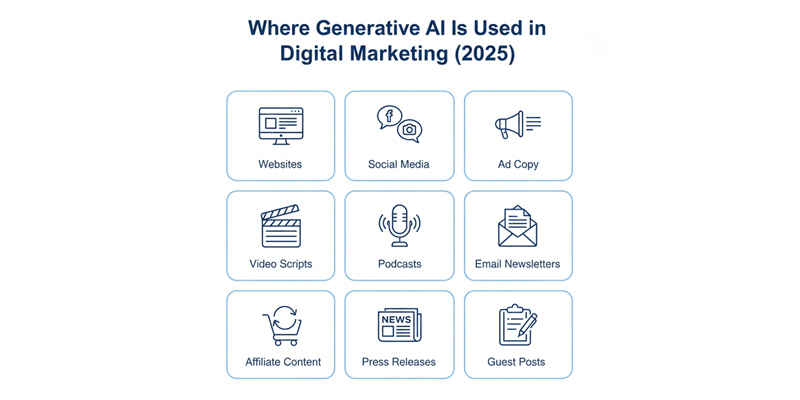
Today, digital marketers use GenAI across almost every platform and content format.
1. For Websites
GenAI helps write blog posts and website content quickly, reducing effort while maintaining consistency and SEO value.
2. For Social Media
Marketers use AI to generate captions, hashtags, and fresh content ideas for different social media platforms, making daily posting easier.
3. For Ad Copy and Ad Creatives
Digital advertisers rely on GenAI to create catchy ad headlines, descriptions, multiple ad variations, and even matching visuals.
4. For Podcasts
GenAI assists with podcast scripts, intro lines, interview questions, episode summaries, show notes, and titles.
5. For Video Scripts
From YouTube Shorts to long-form videos, GenAI can write video scripts in minutes, helping creators publish content faster.
6. For Email Newsletters
GenAI creates subject lines that get opened and writes clear, engaging email content—perfect for promotions, updates, and storytelling.
7. For Affiliate Marketing
AI helps write product reviews, buying guides, and comparison lists that sound natural and help users make quick decisions.
8. For Press Releases
GenAI produces professional press releases with the right structure, tone, and key details—ready for media distribution.
9. For Guest Posting
Marketers use GenAI to create guest posts tailored to a website’s style, improving approval rates and outreach success.
This doesn’t mean human creativity is being replaced. Instead, AI handles the repetitive tasks so marketers can focus on strategy, storytelling, and big creative ideas that truly connect with audiences.
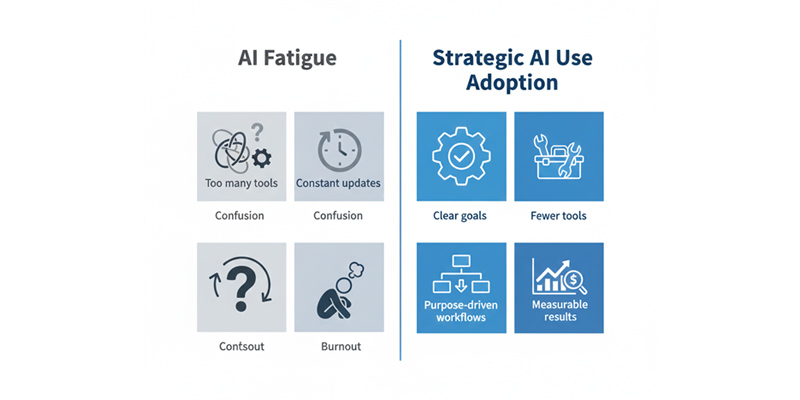
One of the biggest AI trends in 2025 isn’t a new tool or technology—it’s AI fatigue. As AI adoption in digital marketing accelerates, many marketers feel constant pressure to keep up. New AI tools are launching every week, and teams are expected to master them instantly. Businesses are focusing on strategy and purpose-driven tools in digital marketing 2025.
While AI promises efficiency and better results, the reality often feels overwhelming. Marketing teams are juggling multiple platforms without clear direction, unsure which tools actually deliver value. Instead of saving time, AI sometimes adds more complexity to daily workflows.
According to the Digital Marketing Institute’s 2025 trends report, the rapid growth of AI tools has left many marketers feeling stressed and uncertain about where to focus their efforts. This growing burnout highlights the need for smarter AI strategies—not just more tools.
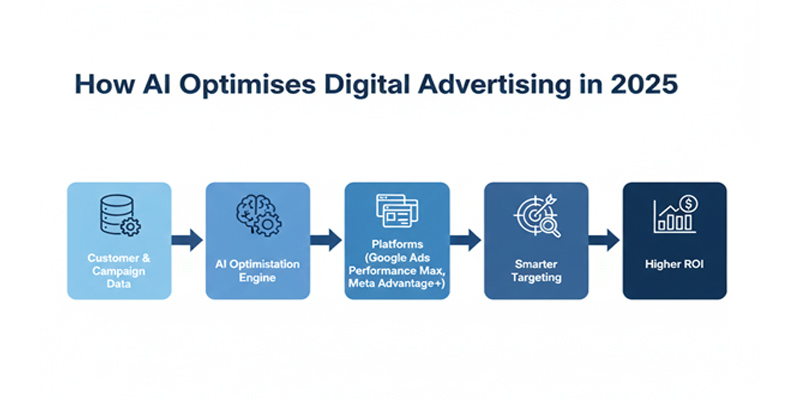
AI is transforming digital advertising like never before. Among the latest AI trends, its impact on advertising is one of the most powerful and measurable. Traditional guesswork and broad audience targeting are quickly being replaced by data-driven, AI-powered ad campaigns.
Today, machine learning helps advertisers reach the right audience with the right message at the right time. Platforms such as Google Ads and Meta now rely heavily on AI to improve ad performance and maximise returns.
Google’s Performance Max uses AI to automatically show ads across multiple channels, analysing real-time data to identify where your ads will perform best. Similarly, Meta Advantage+ uses past campaign data to optimise targeting, placements, and delivery.
Programmatic advertising platforms like The Trade Desk take this a step further by enabling fast, data-led decisions, helping brands optimise campaigns in real time. As a result, AI-driven advertising delivers better targeting, improved efficiency, and stronger ROI for businesses. Measuring ROI and optimising customer experiences are top priorities in digital marketing 2025.
Here’s the reality: while many businesses are experimenting with AI, very few are using it with a clear strategy. According to a 2024 McKinsey survey, only about 25% of organisations have an enterprise-wide roadmap for generative AI.
Trying out new AI tools can be exciting, but without a clear plan, these efforts often remain scattered and fail to deliver long-term results. Random experimentation rarely leads to real business impact.
It’s also important to remember that AI isn’t needed everywhere. Businesses should concentrate on areas where AI can deliver the highest ROI and support their brand’s core strengths.
The real challenge now is this: how can marketers move from testing AI tools to using AI strategically for measurable growth and execution?
As AI adoption in digital marketing continues to grow, businesses need clear and practical strategies. The key question is no longer whether to use AI, but how to integrate it into marketing workflows to support business goals and deliver real results. AI and automation are driving major changes in business marketing in 2025.
Effective digital marketing strategies for AI focus on purpose-driven use rather than chasing every new tool. When AI aligns with your brand objectives, it enhances performance, decision-making, and overall marketing effectiveness.
Start by reviewing the AI tools and platforms you already use. Ask a simple question: are they actually delivering results? If not, it’s time to remove what isn’t working.
Instead of using too many tools, focus on two or three high-impact AI use cases, such as content planning, audience targeting, or customer segmentation. Building expertise in fewer areas helps teams work more efficiently.
This focused approach is key to a successful AI marketing strategy. It lowers the confusion, saves time, and ensures your efforts deliver real, measurable value. Personalised customer experiences are shaping the latest business marketing changes.
AI tools are evolving quickly, but there’s no need to learn everything at once. Even setting aside 30 minutes a week to understand AI in digital marketing can make a big difference. You can explore new features, read real-world case studies, or join short online training sessions.
The goal is to build confidence over time. When marketers stay informed, they make smarter decisions and use AI with purpose—not just because everyone else is doing it. This steady learning approach leads to more effective and strategic AI adoption.
Clean, well-organised data is the foundation of successful AI marketing. Before expecting strong results, ensure your advertising and customer data are accurate, complete, and properly structured.
Once your data is ready, start small. Try simple experiments such as A/B testing AI-optimised ad creatives or audience segments. These small steps help reduce guesswork, improve decision-making, and deliver better ROI without using extra time or resources.
To use AI at scale and avoid risks, businesses need a strong AI governance plan. This means assigning clear ownership for AI tools, following data privacy and compliance policies, and regularly reviewing tool performance.
A well-defined AI governance framework helps reduce risk, improve accountability, and ensure your AI efforts support long-term business and digital marketing goals.
As generative AI becomes an essential part of digital marketing and content creation, creating a shared prompt library can make a big difference. A prompt library helps maintain brand voice, improves the quality of AI-generated content, and saves marketing teams time.
By reusing proven prompts, businesses can ensure consistency across campaigns while achieving faster, more reliable results from AI tools.
AI tools are robust, but their success depends on the people using them. In 2025, businesses that invest in AI training and upskill their marketing teams will stay ahead of the competition.
Creating simple AI playbooks, running internal workshops, and identifying AI champions within your team can make a big difference. These steps help teams use AI with confidence, apply it strategically, and achieve better digital marketing results.
As a digital marketer in 2025, the expectation isn’t just to keep up with AI—it’s to lead with it. But you don’t need to adopt every new tool or follow every trend. What matters most is clarity and focus.
Whether you’re automating email campaigns, creating content, or improving customer service chatbots, use AI with purpose. Align every tool and workflow with your marketing goals.
Rather than spreading yourself thin across platforms, focus on AI tools that enhance speed, creativity, targeting, or scalability. Today, digital marketing roles are evolving—not by doing more, but by doing what matters most, smarter and faster, with AI as your ally. Businesses are focusing on strategy over tools in the new wave of business marketing changes. A successful marketing strategy reset focuses on using fewer, high-impact AI tools to improve targeting, personalisation, and decision-making rather than chasing every new trend.
AI has transformed digital marketing in 2025, but success isn’t about doing more—it’s about doing things smarter and with purpose. For business owners, a marketing strategy reset in 2025 is about prioritising strategy, data quality, and long-term growth over automation without direction.
At Bud, a leading Digital marketing agency, we know it’s not necessary to master every tool. What matters is having a learning mindset and focusing on what truly works for your business.
Beyond the hype is where real results happen. Ask yourself: are you using AI as part of a clear, thoughtful strategy—or just reacting to trends?
WE ARE AN OFFICIAL GOOGLE PREMIER PARTNER